The Challenge
Modern businesses generate more data than ever — from operational systems, from connected devices, from logistics platforms, from financial tools.
The problem is rarely a lack of data. It is that the data lives in too
many places, in too many formats, and requires too much manual effort to turn
into something actionable. Dashboards get built once and then go stale. Reports
are pulled on demand, when someone remembers to ask. Alerts don't exist —
problems are discovered when they become visible, which is usually when they
are already costing you something.
The gap between the data you have and the intelligence you need remains
stubbornly wide.
The main challenges include:
Data scattered across multiple systems with no unified view — every analysis starts with a manual data-gathering exercise
Static dashboards that reflect the past, not the present — useful when built, outdated within weeks
No proactive alerting — teams react to problems instead of anticipating them
Extracting insight requires technical expertise most operational teams don't have in-house
External data sources cannot easily be combined with internal systems, forcing parallel analysis and manual reconciliation
The Solution
You interact with your data in plain language, receive automated alerts the moment conditions you define are met, and access visual dashboards that update in real time.
The platform is built on open-source components and deployed on a dedicated environment — either installed on your own premises or hosted on a dedicated instance in the cloud — so your data is always isolated, never shared with other customers, and fully under your control.
It adapts to your systems, not the other way around.
1
Connect your data sources
The platform connects to your existing systems — operational databases,
IoT data streams, business applications, file exports — without requiring you
to migrate or replace anything. Your data stays where it is; the platform reads
it, normalizes it, and makes it available for analysis in a unified interface.
2
Ask questions, build dashboards, schedule reports
Query your data in plain language without writing code or navigating
complex filter menus. Build visual dashboards that combine data from multiple
sources in a single view. Schedule reports to be delivered automatically by
email or Telegram at the frequency you need — daily summaries, weekly
overviews, monthly reviews. Everything is configurable without technical
intervention.
3
Define alerts that watch your operations for you
Set threshold conditions across any connected data source — a machine
metric exceeding a safe range, a logistics KPI falling below target, a
financial indicator moving in the wrong direction — and receive an instant
notification on Telegram or email the moment the condition is triggered. Alerts
can be routed to different recipients depending on type and severity, keeping
the right people informed without noise for everyone else.
4
Dedicated environment — on your premises or in the cloud
The platform is deployed on a dedicated environment sized for your needs
— either installed on your own premises or hosted on a dedicated cloud instance
where your data is completely isolated from other customers. We help you choose
the deployment model that best fits your security requirements, your budget,
and your operational constraints.
Technology Stack

Grafana
Open-source platform for data visualization and dashboard management.
Grafana connects to a wide range of data sources, renders real-time visual
dashboards, and serves as the primary interface through which users explore
their data and monitor live metrics — without writing a single line of code.
Anthropic Claude AI
The natural language interface is powered by Claude, Anthropic's AI
model. It interprets plain language questions about your data, translates them
into accurate queries across connected sources, and returns structured,
readable answers — making your data accessible to anyone on your team,
regardless of their technical background.
Telegram & Email
Alerts and scheduled reports are delivered via Telegram or email —
whichever fits your team's workflow. Telegram notifications are instant and
actionable, suited for time-sensitive operational alerts. Email delivery is
ideal for scheduled reports and summaries that need to reach a broader audience
or be archived. Key Benefits
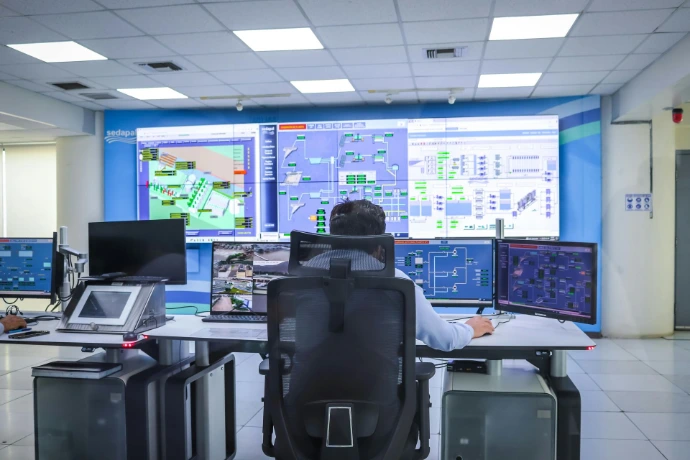
From scattered data to a single source of truth
When your data lives in separate systems, every analysis is preceded by a data-gathering exercise that takes longer than the analysis itself.
By connecting all your sources into one platform, you eliminate that overhead entirely. Your team stops spending time preparing data and starts spending time understanding it — and acting on it.

Intelligence that works while you sleep
Automated alerts mean you don't need to check dashboards to know when something needs your attention.
The system monitors your operations continuously — across all connected sources — and reaches out to you the moment a defined condition is met, day or night. You shift from reactive to proactive, without adding a single person to your team.

Your data, isolated and under your control — wherever it runs
Unlike shared cloud analytics platforms where your data sits alongside other customers' data on the same infrastructure, this solution runs on a dedicated environment — whether on your premises or on a dedicated cloud instance.
Your data is never shared, never mixed, and always accessible only to you. You choose the deployment model that fits your needs; we handle the rest.